
Your shopping cart
The Origins of Socks as a Fashion Symbol: A Historical Perspective
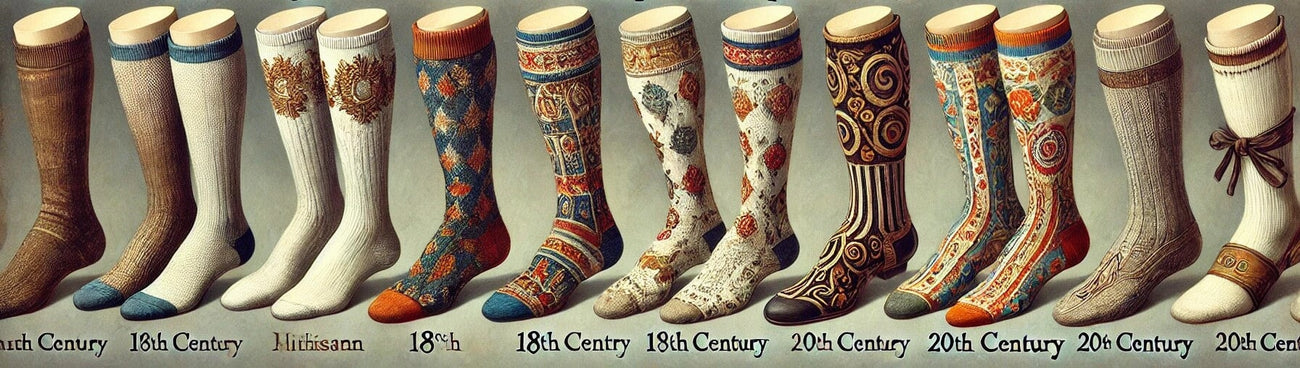
How Socks Became a Fashion Symbol – A Historical Perspective
Socks, these seemingly modest accessories, have a long and fascinating history that traces their journey from pure practicality to true fashion symbols. From ancient times to the present day, socks have undergone a remarkable transformation—evolving from simple foot protection into an important element of style and individuality. Let’s explore this evolution and see how socks have changed over the centuries.
8th Century BC – Ancient Greece: The First Socks
The origins of socks can be traced back to Ancient Greece, where early versions were made from felted animal hair or leather. Their primary purpose was warmth and protection, as the materials and technologies of the time did not allow for the comfort and variety we know today. Nevertheless, these simple socks laid the foundation for what would become an essential part of our clothing.
2nd Century BC – Ancient Rome: The Transition to Knitted Socks
With the advancement of Roman civilization, socks began to be made from knitted fabrics. These were softer and more comfortable than earlier versions, marking an important step toward the modern socks we wear today. This shift represented the first real attempt to introduce functionality and comfort into this garment.
The Middle Ages: Socks as a Symbol of Status
During the Middle Ages, socks evolved from a basic necessity into a symbol of social status. The wealthy wore fine silk socks, while the lower classes relied on wool. Closely associated with the church and the aristocracy, socks became a way to demonstrate wealth and social standing. In this period, they acquired not only a practical role but also a strong social meaning.
1589 – The Invention of the Knitting Machine
The invention of the first knitting machine in 1589 made sock production faster and more efficient. This innovation made socks more accessible and opened the door to a wider variety of styles. Mass production allowed for greater diversity in design and affordability for different social groups, laying the groundwork for the modern sock industry.
1938 – The Introduction of Polyamide: The Rise of Synthetic Materials
In the late 1930s, polyamide—better known as nylon—was introduced and revolutionized the textile industry. Nylon socks quickly gained popularity due to their strength, elasticity, and durability, setting a new standard for comfort and practicality. This breakthrough paved the way for the wide range of materials and sock styles available today.
2020 and Beyond: Socks as an Expression of Style and Creativity
Today, socks are no longer just a necessity—they are a form of self-expression and creativity. With brands like ArtyShocks, modern socks have become wearable art. Bright, colorful, and often featuring fun and unique designs such as animals, caricatures, or art-inspired prints, these socks carry a clear message: they are not just clothing items, but a way to stand out and showcase creativity and personal style.
Conclusion
Socks have come a long way—from a basic need to a fashion accessory that can even be considered a piece of art. They reflect society and culture, evolving from symbols of status and wealth into an integral part of modern personal style. Whether you prefer classic designs or bold, colorful, and playful socks, every pair tells its own story. At ArtyShocks, we are proud to offer not just socks, but accessories that bring smiles and positive energy to every outfit.